North Cyprus Guide
History And Landmarks Of North Cyprus
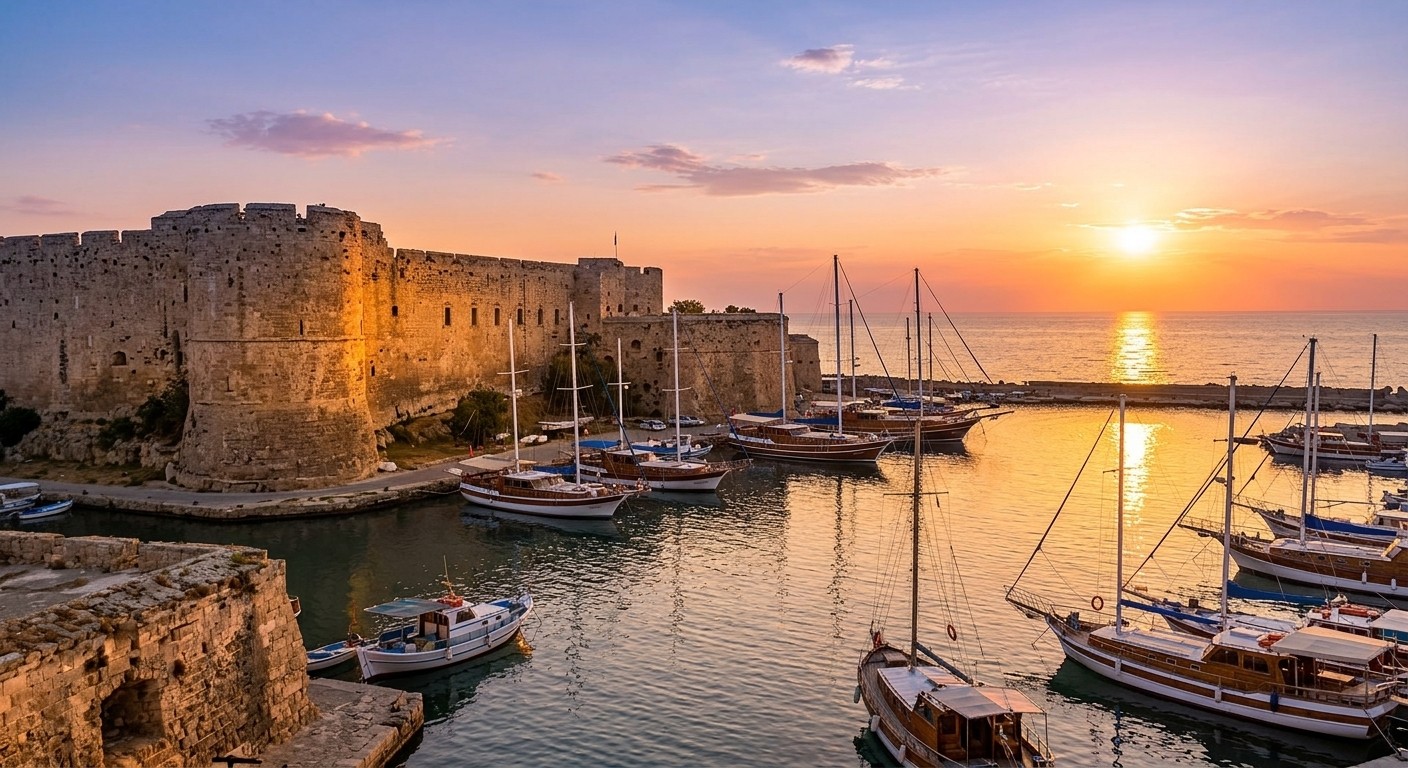
For such a small coast, North Cyprus is extraordinarily rich in history – everyone who ever mattered in the Mediterranean passed through and left their mark in stone. From mountain-top Crusader castles to Roman ruins by the sea, these are the landmarks that tell the island’s story.
Part of our North Cyprus Guide.In this guide
Kyrenia Castle and the Shipwreck Museum
Kyrenia Castle is the great stone fortress curling around the old harbour of Kyrenia. Inside its thick Venetian walls are dungeons, a Byzantine chapel and the Shipwreck Museum – home to the oldest recovered trading vessel in the world, a Greek ship that sank more than 2,300 years ago.
The castle and the harbour
Start here. The castle guards the horseshoe harbour that is the heart of the old town, and from its ramparts you get the classic view of North Cyprus: restored merchant houses and cafes, wooden boats on turquoise water, and the mountains behind. Allow at least an hour to walk the walls and chambers – it is bigger inside than it looks.
A layered history
What you see is mostly Venetian, rebuilt in the sixteenth century with massive low walls to withstand cannon fire. But there was a fort here in Byzantine times, extended by the Crusader Lusignan kings and later held by the Ottomans and British. A walk through it is a walk through eight hundred years of the island’s story.
The Shipwreck Museum
In a vaulted hall lie the timbers of a small Greek merchant ship that went down off this coast around 300 BC – raised, preserved and displayed with the amphorae and millstones she was carrying on her final voyage. It is the oldest recovered ship on show anywhere in the world, and quietly moving to stand before.
Q&A
What is inside Kyrenia Castle?
Dungeons, a small Byzantine chapel, towers and courtyards, and the Shipwreck Museum, which holds the world’s oldest recovered trading ship – a Greek vessel that sank around 300 BC.
How long do you need at Kyrenia Castle?
Allow at least an hour to walk the walls, explore the chambers and see the Shipwreck Museum; history lovers can easily stay longer.
Is there an entrance fee?
Yes, a modest entrance fee, with longer opening hours in summer than winter – check current times before you go.
Bellapais Abbey: The Abbey of Peace
Bellapais Abbey is a beautiful Gothic monastery in the hillside village of Bellapais, just above Kyrenia. Often called the Abbey of Peace, its graceful cloisters and refectory, open to the sea breeze and framed by cypress trees, make it one of the finest medieval ruins in the eastern Mediterranean.
A ruin like no other
There are grander castles in North Cyprus, but few places as lovely. The abbey sits on a shelf of the mountain, so from its terraces you look over olive groves to the sea. Much is roofless now, but enough survives – the pointed cloister arches, the vaulted refectory, the near-intact church – to make people who plan an hour stay all afternoon.
The Abbey of Peace
Founded around 1200 for Augustinian canons who had fled the Holy Land and extended under the Lusignan kings, its white-robed community gave it the old name the White Abbey; the French Abbaye de la Paix – Abbey of Peace – softened into Bellapais. That calm still hangs over it today.
The village and its writer
The village is as much a reason to come as the abbey: steep stone lanes, bougainvillea, and terrace restaurants looking out to sea. It found lasting fame through the British writer Lawrence Durrell, who lived here in the 1950s and wrote about it in Bitter Lemons. In the square grows the famous Tree of Idleness, said to bring a pleasant laziness to anyone who sits beneath it.
Q&A
Why is it called the Abbey of Peace?
From the French Abbaye de la Paix, which became Bellapais. The white-robed canons who lived there also gave it the nickname the White Abbey.
How old is Bellapais Abbey?
Founded around 1200 and extended under the Lusignan kings in the 13th to 14th centuries – more than 800 years old.
Can you visit Bellapais Abbey?
Yes, it is open most of the year with a small entrance fee, in Bellapais village a short drive up the hill from Kyrenia.
Salamis Ancient City: Rome by the Sea
Salamis is the great ancient city of North Cyprus, a sprawling site of Greek and Roman ruins on the coast near Famagusta. Founded around three thousand years ago and once the island’s capital, it spreads over a wide area of columns, baths, a theatre and mosaics, right beside a quiet beach.
Walking through antiquity
Salamis rewards a slow wander. The showpiece is the Roman theatre, restored enough to climb and imagine full, and the gymnasium and bath complex with their rows of marble columns and fragments of mosaic and statuary. Because the site is large and open, you often have whole stretches to yourself – a rare thing among Mediterranean ruins.
Three thousand years of history
Salamis was among the most important cities of ancient Cyprus, a Greek foundation that flourished under the Romans before earthquakes and raids left it to the sand. Layers of Hellenistic, Roman and early Christian history sit side by side here, from the theatre to the ruins of basilicas.
Sea, sand and combining your visit
The ruins run almost to the shore, so many people pair a morning at Salamis with an afternoon on the adjacent beach. It sits near Famagusta and its walled old town, and within reach of the Karpaz Peninsula, making an easy day out along the historic east coast.
Q&A
What is Salamis famous for?
Being the great ancient city of Cyprus – a Greek and Roman capital with a large, well-preserved site including a Roman theatre, gymnasium and bath complex near Famagusta.
How old is Salamis?
It was founded around 3,000 years ago and flourished especially under the Romans, before earthquakes and raids led to its decline.
Is there an entrance fee, and is there a beach?
Yes, there is a modest entrance fee, and the site sits right beside a quiet beach, so many visitors combine the ruins with a swim.
St Hilarion and Kantara: The Mountain Castles
St Hilarion and Kantara are two Crusader castles perched high in the Besparmak mountains. St Hilarion, above Kyrenia, is said to have inspired Disney’s Snow White castle; Kantara guards the eastern end of the range towards the Karpaz. Both reward the climb with sweeping views over both coasts.
St Hilarion: a castle in the clouds
This is the one that stays with people – a fortress scattered up a mountainside in three tiers, its walls following the rock so closely they seem part of it. On a misty day the towers float in the cloud. The Lusignan kings used it as a fortress and cool summer residence, and legends cling to it, most famously the tale of Prince John and his bodyguards thrown from a tower.
Kantara: the quiet eastern watchtower
Far to the east, Kantara is smaller, wilder and far less visited, standing guard where the mountains taper towards the Karpaz Peninsula. From its walls you can see both the north and south coasts at once. It makes a natural stop on a drive out to the wild east of the island.
The climb, and planning
St Hilarion involves a steady uphill walk and well over a hundred uneven steps to the summit, so wear proper shoes and take water, especially in summer. Both castles are a drive up into the mountains, with modest admission and longer summer hours. Mornings are cooler and best for photographs.
Q&A
Did St Hilarion inspire Disney’s Snow White?
It is widely said to have inspired the castle in Snow White, and its dramatic towers rising from the crags fit the story. It is one of the island’s most photographed sights.
How many steps at St Hilarion Castle?
Reaching the upper ward involves a steep path and well over a hundred uneven steps, so comfortable shoes and water are recommended.
Which castle is better to visit?
St Hilarion is the more spectacular and accessible, above Kyrenia; Kantara is quieter and wilder in the east – pair it with a Karpaz day trip.
Famagusta Walled City: Gothic Splendour on the East Coast
Famagusta’s walled old town is one of the most atmospheric places in North Cyprus – a ring of massive Venetian walls enclosing Gothic churches, Ottoman mosques and narrow lanes. At its heart stands the great cathedral of St Nicholas, now the Lala Mustafa Pasha Mosque, a soaring piece of French Gothic beside the palm trees.
Inside the Venetian walls
The walls that ring the old town are among the finest surviving Venetian fortifications anywhere – thick ramparts and bastions built to hold off the Ottomans. Within them, the medieval street plan survives, dotted with the ruins of the many churches that once earned Famagusta the nickname the city of a thousand churches.
The cathedral and Othello’s tower
The showpiece is the former Cathedral of St Nicholas, a magnificent Gothic building begun in the fourteenth century and later given a minaret when it became a mosque – Gothic arches and a Mediterranean sky in one view. Nearby, the Othello Castle carries the name Shakespeare gave it in his play, on the harbour walls.
A living old town
Unlike a museum, this is a lived-in town of cafes, students from the local university and market stalls among the monuments. It pairs naturally with the ruins of Salamis just up the coast, making a full day of the historic east.
Q&A
What is Famagusta famous for?
Its massive Venetian walls, its Gothic former cathedral (now the Lala Mustafa Pasha Mosque), Othello’s Castle, and its many medieval churches – the city of a thousand churches.
Can you go inside the old city?
Yes – the walled old town is open and lived-in, with cafes and shops among the monuments. The former cathedral is an active mosque, so dress modestly to enter.
Is Othello’s Castle real?
Yes – the citadel on Famagusta’s walls is popularly known as Othello’s Castle after Shakespeare set part of his play in the city.